China Visa-Free Travel 2026: Entry Process, Arrival Card & My Experience
Many travellers have viewed China as a difficult destination to visit. The language barrier, the fact that different apps are needed, and mostly because of having to get a visa. Visa applications, cost, and uncertainty around the entry process add an extra barrier to entry that a lot of people simply don’t want to navigate.
For years, I have applied for many different visas to live in and visit China, and whilst I’m happy to go through the process, it can be frustrating, long and costly. With the new visa-free policies now available for many countries around the world (even the UK), travelling to China is easier than ever before.
I recently travelled to China visa-free, and wow, what a difference. In this article, I’ll walk you through my recent experience entering China, how the visa-free process worked, what the online arrival card was like, and why I think China is becoming one of the easiest/best countries in Asia to travel independently.
China’s visa-free entry is a HUGE change
Over the past few years, China has expanded its visa-free entry policies for many countries, making short-term travel dramatically easier than before.
Depending on your nationality, you may now be able to enter China without applying for a traditional tourist visa. In 2026, the UK was added to the list of countries, and I am very happy to make the most of this new visa-free travel.
This removes one of the biggest barriers that previously stopped people from visiting China.
Instead of dealing with embassy appointments, paperwork, and waiting times, the process can now be surprisingly straightforward, and you can book a flight and go whenever you like.
Is your country eligible?
Here is a list of countries that qualify for visa-free entry as of May 2026:
Europe (35 countries): Andorra, Austria, Belgium, Bulgaria, Croatia, Cyprus, Denmark, Estonia, Finland, France, Germany, Greece, Hungary, Iceland, Ireland, Italy, Latvia, Liechtenstein, Luxembourg, Malta, Monaco, Montenegro, Netherlands, North Macedonia, Norway, Poland, Portugal, Romania, Russia, Slovakia, Slovenia, Spain, Sweden, Switzerland, United Kingdom
Oceania (2 countries): Australia, New Zealand
Asia (7 countries): Bahrain, Brunei, Japan, Kuwait, Oman, South Korea, Saudi Arabia
Americas (6 countries): Argentina, Brazil, Canada, Chile, Peru, Uruguay
How long can you stay in China?
You can stay in China for 30 days visa-free if you are from one of these countries.
If you wish to stay longer than 30 days, you will have to apply for a tourist visa from your embassy, or you can either leave China and reset your visa for another 30 days, and you can do this as often as you like.
You can travel to China visa-free for business, tourism, visits to relatives and friends, exchange visits, or transit.
Do you need any documents for visa-free travel?
You need:
Your passport from one of the eligible countries – It must be valid for at least 6 months after your arrival date and have enough blank pages to get stamped.
Proof of onward travel or return flight – you need to show that you will leave China within the 30-day visa-free period.
Proof of accommodation – Your first hotel booking confirmation, a tour itinerary or an invitation from your host.
I would also recommend checking the official embassy pages before travel, as the visa rules are constantly updating and changing.
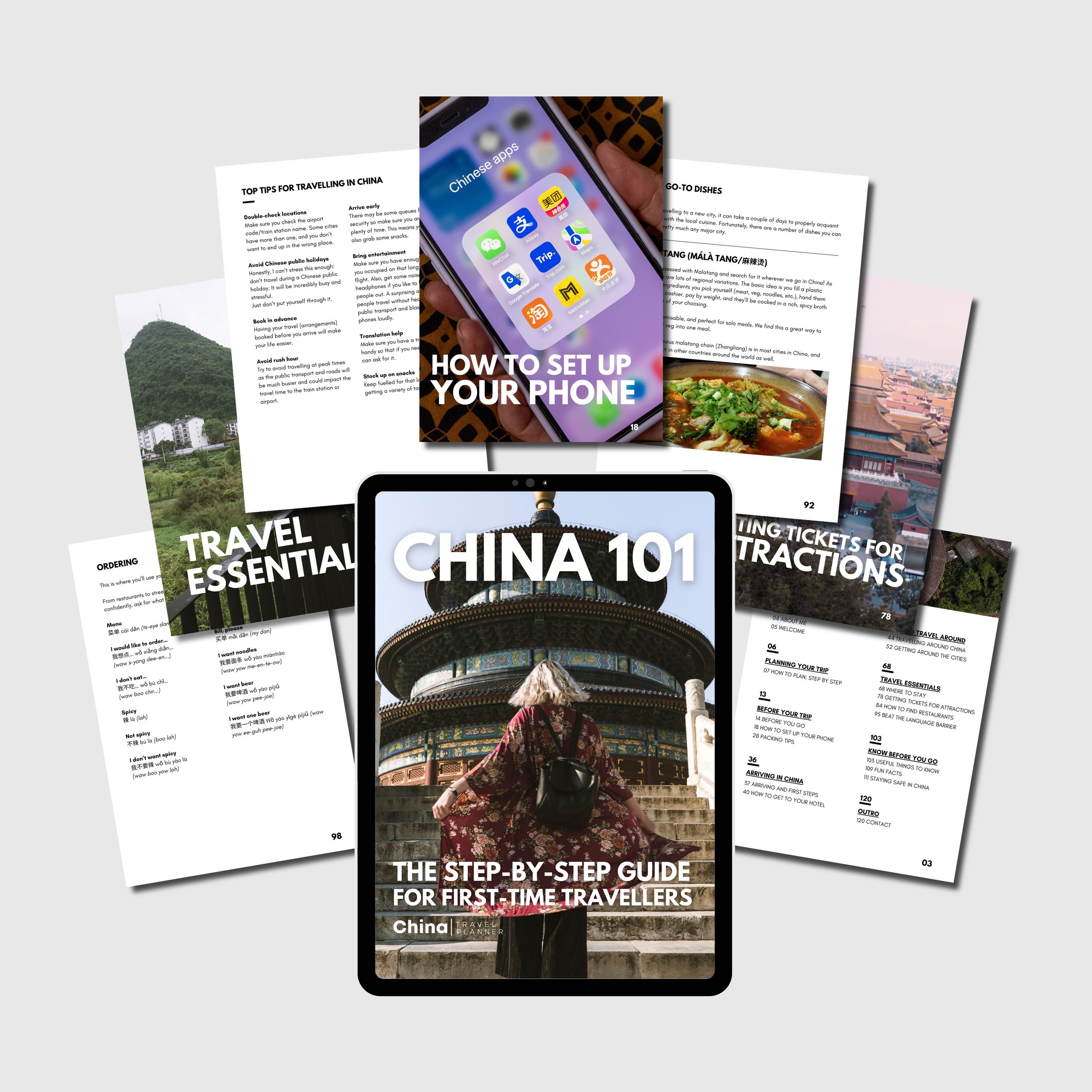
First time in China?
This guide has everything you need to know!
It has a whole section on arriving at the airport and how to get to your hotel.
Save yourself hours of time and stress by having everything you need in one guide.
My recent visa-free experience in China
I recently entered China using the new visa-free policy, and the process was much smoother than I expected. I travelled to Beijing Capital Airport, the immigration line was empty, and the officer spoke English.
Before arriving, I completed the online arrival card, which only took a few minutes. This is the same as the paper arrival card you would normally fill in, but they have made it digital to help streamline the arrival process. If you don’t fill this in before arriving, then don’t worry, you can still do this in China at the machines. There are people around to guide you in the right direction.
The form was straightforward and mostly asked for standard travel information, such as:
passport details
flight information
accommodation address
purpose of visit
After submitting it, I received a QR code, so I screenshotted the confirmation to save on my phone to show the immigration officers. I didn’t need to print anything off.
At immigration, the officers simply checked my passport, asked a couple of standard questions, got my fingerprints, and verified my entry details. They then stamped my passport with my arrival date. They didn’t ask for my onward flight or accommodation details, but as I had already filled in the arrival card, I assume they have access to this information anyway.
This online arrival card definitely made it a lot quicker and easier, especially as I had already filled it in before my arrival. Immigration was kind of the same experience, the real time saver for me was not having to go to Manchester, London or Edinburgh to apply for a visa and take my passport in.
The immigration process was so fast that it took way longer to get my bags and scan them through the security machines.
The online arrival card process
I thought the online arrival system was really good and saved a lot of time. Although the paper card was easy to fill in, finding the information (and a pen) once you arrive is more difficult than knowing everything is sorted beforehand.
The system was in English and easy to fill in.
Once you have received the confirmation QR code when you have filled it in successfully, take a screenshot on your phone so you can easily access it when you arrive without needing access to the internet.
I would still recommend:
Having your flight details somewhere handy
Saving your hotel address in English and Chinese – especially if you need to get a taxi from the airport.
China is becoming easier for independent travellers
One of the biggest misconceptions about China is that it’s difficult to travel independently.
But in reality, things are becoming easier every year:
mobile payments are more foreigner-friendly
High-speed rail is incredibly efficient and easy to book
translation apps work well
major apps now support international cards
and visa-free entry removes a major obstacle
If you are still feeling overwhelmed by it all, that’s totally normal, and that’s why I created this website to help people who need extra help with their trip to China.
Of course, China still feels different from travelling in Europe or Southeast Asia, but that’s also part of what makes it such an exciting destination.

Need extra help planning your trip?
I offer 1-to-1 China travel planning calls where I help you plan your itinerary, transport, apps, and logistics so your trip runs smoothly.
Why I think China is the best destination to travel to in 2026
The visa-free policy is on a trial basis until 31 December 2026. Although this has been extended a few times already, you never know when they might change this, so it is better to travel in 2026 while it’s still visa-free.
The visa-free policy has certainly boosted tourism in China, but it is still not a super popular destination… yet. This could all change in the future, so get there before it gets too busy.
China is an adventure, and a lot of people are looking for something different. It is one of the most diverse countries in the world, from mountains to jungles, beaches to grasslands. It has some of the most futuristic megacities in the world, stunning rural destinations, history that dates back thousands of years, and the most incredible food to try.
It has something for all ages, enthusiasts, and abilities.
At the moment, China is an affordable destination. It is not the cheapest country, but you get a lot for your money when you travel there, especially in second-tier cities where you can find great hotels for $25 and street food for $1.
Tips for First-Time Travellers to China
If you’re considering visiting China for the first time, here are a few things I’d recommend preparing before arrival:
Download these apps before arriving
Install an eSIM or get a VPN before entering China
Save hotel addresses in Chinese and English and check where they are on a map
Have offline maps ready
Have offline translation downloaded
Keep screenshots of bookings and documents
Once you arrive, you’ll probably realise that many of the fears people have about travelling to China are outdated.
So, if China has been on your bucket list but the visa process previously put you off, now may be the perfect time to reconsider.
And honestly, once you arrive, you’ll probably wonder why you didn’t visit sooner.
Check out some of my other posts to help you with your trip